

AI-Enabled Systems Design Masterclass
Learn how to drive end-to-end experience change with the AI-Enabled Systems Design Masterclass.

Register
Register for the class through Tech Fleet:
Class Timeframe
- 5 weeks
- 4 hour class commitment per week
- 5 hour homework commitment per week
- 20 total live class instruction hours
Class Level
This is a class to take after taking the introductory scenario-based problem solving class. You will apply what you learn from that class in this class's topics.
Overview
The study of how humans interact with the world deals with intricate pieces. People go through a complex journey: first they become aware, then they start engaging, then they decide, then they act, then they stick around or not, and then they become advocates for the things they use. Along the way, they will interact with multiple things: people, software, environments, communications, and other tools. There could be lots of points where people abandon the path and stop.
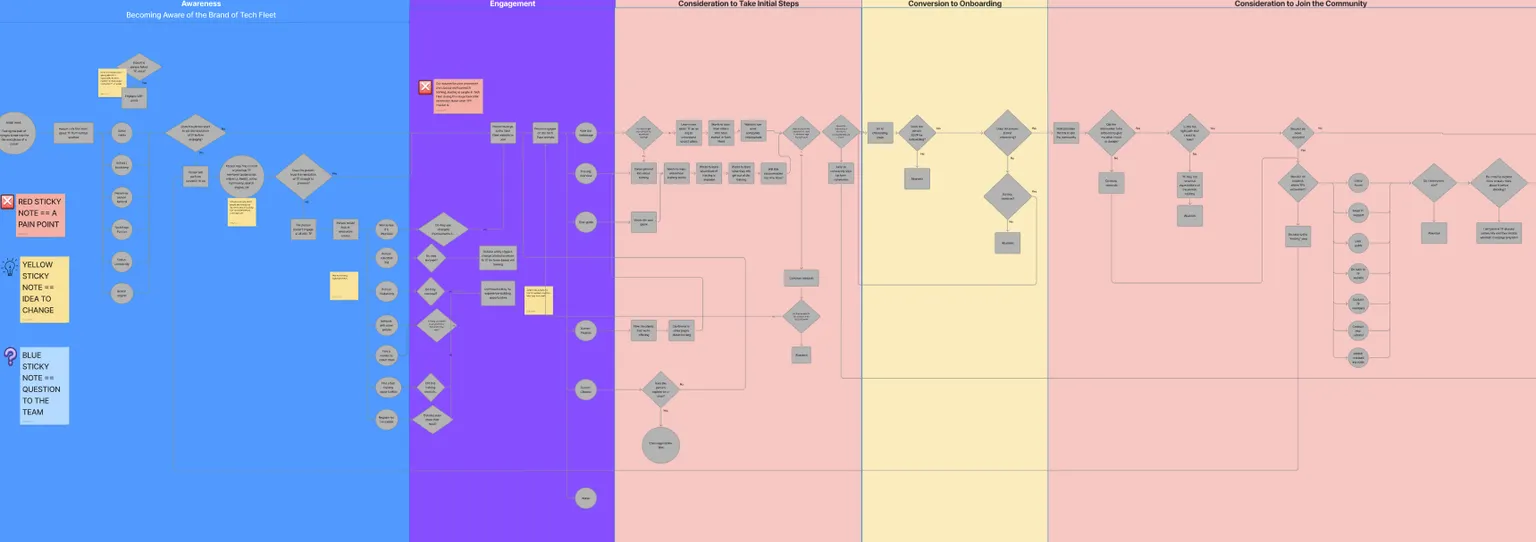
A “System” is a combination of multiple touch points that humans interact with. Systems design deals with honing the entire end-to-end experience, from awareness to advocacy, and everything in between, for all touch points. All kinds of industries will rely on end-to-end experience, and this class will cover general work that applies to lots of different kinds of professional environments. In this class, you learn how to map end-to-end experiences into components: touchpoints, tasks, motivations, decisions, pain points, and tools used. The map serves as the basis for forming strategy and innovating around how to make change within systems in the world.
This 5 week immersive class teaches you everything you need to know about how to study, analyze, design, and change systems that businesses maintain.
Why Take This Class?
UX designers, UX researchers, and product managers in the future will be doing a whole lot more than just the things they’ve been trained in. We’re already seeing examples of jobs requiring strategy, business, and operations work. Software, hospitals, restaurants, golf courses, and so much more require end-to-end experience design. By studying awareness, engagement, decision-making, action, retention, and advocacy as a single continuous system rather than isolated events, students develop a holistic understanding of how experiences succeed or fail. It equips students with the ability to think in systems, not just artifacts, and to design with both intent and insight. Designing end-to-end experiences and systems that interact with each other is a crucial skill to master to be able to professionally develop in the world.
Skills Taught in This Class
Technical Skills
- Flow Charts
- Problem-Solving
- Critical Thinking
- Customer Experience
- Success Metrics
- Storyboarding
- AI Evaluation
- AI Prompting
Interpersonal Skills
- Buy-in Generation
- Communication
- Collaboration
Deliverables
In this class, you will be taught how to deliver the following:
- Audience Segment Personas
- Empathy Maps
- Customer Experience Strategy
- Customer Experience Maps
- Storyboards
- KPI’s
Audiences
- UX researchers and UX designers
- Product managers, product owners, and business analysts
- Project managers and program managers
- Business leaders
- Operations professionals
Learning Outcomes
- Understand the difference between systems design, service design, and product design
- Map end-to-end experiences for a variety of interaction types
- Identify actors, pain points, decisions, motivations, and tools within single steps of an end-to-end experience
- Document segments of audiences and design the customer experience for each one
- Communicate the value of systems design to different business functions
- Generate buy-in and strategy for decisions that change experiences for humans
- Tell the story of current experiences and future experiences
Weekly Schedule and Dates
Go to the specific page to find your cohort’s schedule:
February 2026
Please check out the full syllabus for schedule of classes and dates: https://tech-fleet-community-dao.notion.site/AI-Enabled-Systems-Design-Masterclass-Syllabus-2c41a3bddce5800886edc390f3a01f88
Costs
This class requires a $50.00 USD registration fee per student.
Register
Register for the class through Tech Fleet:
Curriculum
Week 1 - Introduction to Agile Systems Design
Lecture
- Overview of the class
- Systems design vs. Product design vs. Service design vs. UX design
- Agile UX in action
- Agile development lifecycle
- Approaching product and service delivery in Agile ways
- The process of systems design
- AI’s Place in Systems Design
Class Lab Time
- Examples of systems design
- Systems Design AMA
Week 2 - Understanding the System Today
Lecture
- Assumption forming and assumption testing
- Understanding the current state of the world
- Audiences
- Environments
- Workflows
- Interactions
- Decisions
- Pain points
- Documenting the current state of the world
- How to make flow charts with UML
- Qualitative UX research artifacts to document current state:
- Flow Analysis (AKA Customer Experience Mapping, AKA Flow Charts, AKA Process Mapping)
- User Journeys
- Audience Personas
- Using AI tools to help you document current state
- Working with Clients and Stakeholders in Systems Design
- Approaches to generate alignment
- Assumption mapping with clients
- Assumption mapping with users
Class Lab Time
- Mapping the current experience with flow analysis
- Assumption mapping processes with clients
- Empathy maps
Week 3 - Designing the Future System
Lecture
- Setting the strategy of the future state
- Designing for your audiences
- Improving abandonment in the customer lifecycle funnel
- Implementing strategic decisions in the customer lifecycle
- Telling the story of current experience and future experience
- Why visuals and storytelling are so powerful
- Empathy maps
- Storyboards
- Defining conversion points
- Defining the core of the experience
- The theory of change
- Developing measurements of success for change
Class Time
- Setting Customer Experience Strategy
- Storyboards
- KPI’s
Week 4 - Working Sessions All Week
Class Lab Time
- Document current state assumptions
- Analyze research
- Perform deliverables
- Flow analysis
- Storyboards
- Get feedback about accuracy of current state
- Identify pain points and opportunities
- Develop KPI’s
Week 5 - Implementing the Future System
Lecture
- Mapping the future customer experience
- Communicate the value of systems design to different business functions
- Generate buy-in and strategy for decisions that change experiences for humans
- Using AI tools to communicate change
- Implementing measurements of success within the future systems experience
Class Lab Time
- Future Customer Experience Maps
- Future Storyboards
Class Workshop Templates
Here are the templates we will use in this class that help you build and analyze research:
Reading Assignments
- Klein, L. (2016). Build better products: A modern approach to building successful user-centered products. Rosenfeld Media. Available from Amazon and other sources.
- Stickdorn, M., Hormess, M., Lawrence, A., & Schneider, J. (2018). This is service design doing. O’Reilly Media, Incorporated. Available from Amazon and other sources.
Homework
- Audience segments
- Current customer experience map
- Customer experience strategy
- Storyboards
- Future customer experience map
Class Tools
- Collaboration - We’re going to use Figjam for class collaboration and discussions.
- Communication - We’ll use Maven's portal for communications.
- Class meetings - We’re using Google Meet for class meetings. All classmates will be invited to the calendar invites from the email they use to register.
- Documentation - You should document your homework and assignments in Figjam. This helps you draft and revise content easily, and allows you to work with others to do it.
