

Template: Audience Segments, Motivations , Goals, and Use Cases
Here's a template to sequentially break down audiences and their traits that matter, like goals, motivations, and situations to support.

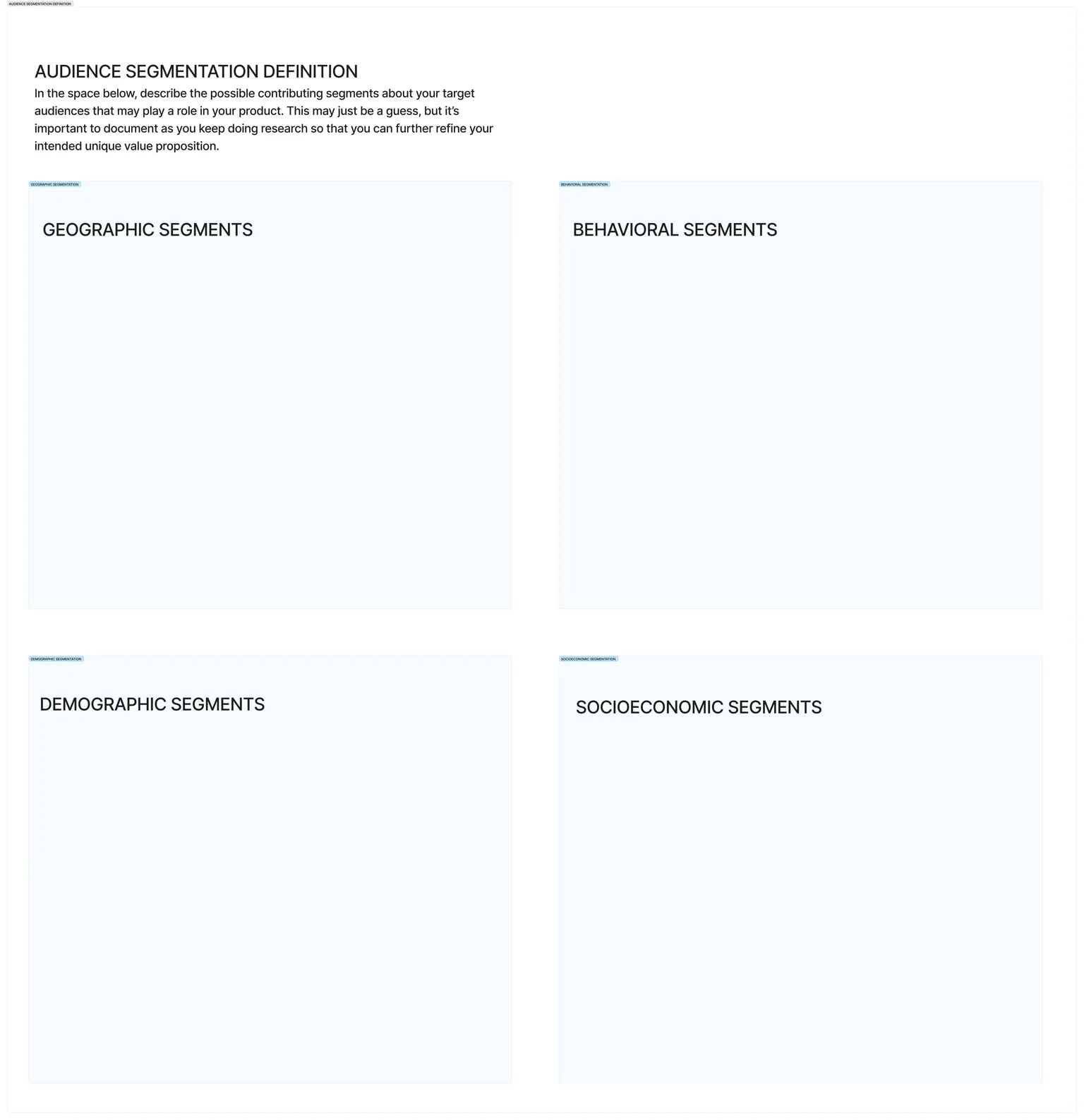
Here's a template for teams to define audience segments and the things that they care about while you go through Discovery milestone work.
What is This?
To properly understand how you should be solving problems for your audiences, teams need to work to understand the day in the life of users. This happens in a variety of ways. It involves a lot of brainstorming, assumption mapping, and research to understand how to communicate goals and motivations of your audiences. Understanding how you want to describe your audience is up to you and the team and the clients involved. You can use Segmentation to describe your audiences from different perspectives: where they live, how they behave, their background, or their socioeconomic status. From there, you can work together to identify the motivations and goals that audiences have, and what kinds of segments are the most valuable to focus on for the business. This workshop helps teams brainstorm about the segmented traits of potential audiences, and communicate what they care about to gain a common understanding.
Why is it Valuable?
This is valuable because:
- The team can align with clients, stakeholders, and each other about the areas of focus that will bring the most value to audiences based on how they describe the audiences.
- The team can base the user research, market research, and implementation of designs based on what they define for segmentation.
When Should it Happen?
This work is done when teams are going through the Discovery milestone in continuous problem-solving operations. Read more about that here.
Goals of the Workshop
- Build semantic labels around audience segments.
- Agree to the audience segment descriptions your team wants to align on.
- Brainstorm motivations, goals, and scenarios to support that will be important to audience segments.
Components of the Workshop
- "Audience Segments" - the ways that you could categorize your target audiences. There are more than one target audiences in what you build. The same person can have different categories and labels depending on where they are in your customer experience.
- "Motivations" - what drives the audience segments differs. This is the reason they interact with your brand, service, product, or environment in the first place. Teams can build more informed solutions when they agree what motivates their audiences.
- "Situational Goals" - These are the things that the audience segments are trying to achieve in specific situations within the experience you're building. There could be a lot of situational goals for each audience that change at every step.
- "Life Goals" - These are the things that the audience segments are trying to achieve in their lifetime. These describe much larger goals than situational goals, but they are related to situational goals. Situational goals are based on someone's motivations and life goals.
- "Use Cases"- These describe scenarios that human beings currently do in your experience. They help teams communicate the current state of experiences or the future end-results that you are striving for.
How to Do It
- Identify potential traits of segments based on:
- Geography
- Behavior
- Demographics
- Socioeconomic status
- Pick the most impactful traits and describe your audiences you want to focus on.
- Identify the motivations of the audience segment.
- Identify the situational goals that audience segment has in the end-to-end experience.
- Identify the use case scenarios that are the most impactful to support for each audience segment.
Expected Deliverables of the Workshop
- Identify semantic labels for audience segments based on what you think are the common traits
- Identify situational goals that are important to support in the release planning
- Identify use case scenarios that are important to support in the release planning
Figjam Template
Miro Template
Coming Soon
Excel Template
Coming Soon
